10 Signs Your Liquor Store Has Outgrown Your POS System
Your liquor store’s POS system should do more than ring up customers and print receipts. It should help you manage inventory, protect your margins, reduce employee errors, understand what is selling, and make better purchasing decisions.
But many liquor stores are still operating on POS systems they installed years ago. The system may technically still work, but that doesn’t mean it is keeping up with the needs of the business.
As your store grows, the difference between a basic cash register system and a modern liquor store POS can translate into hours of additional work, inaccurate inventory, missed margin opportunities, and thousands of dollars tied up in the wrong products.
Here are 10 signs your liquor store has outgrown its POS system.
1. You’re Still Entering Invoices Manually
Receiving inventory should not require someone to sit in the back office entering every case, bottle, cost, and quantity from a distributor invoice.
Manual invoice entry takes time and creates opportunities for mistakes. Enter the wrong cost or quantity and your inventory reports and margins can immediately become inaccurate.
A modern liquor store management platform should automate as much of the receiving process as possible.
Bevly offers Automated Invoicing and Automated Receiving, helping liquor stores update inventory and product information without spending hours manually entering invoices.
2. You Don’t Completely Trust Your Inventory Numbers
Ask yourself a simple question:
If your POS says you have 12 bottles of a product, how confident are you that 12 bottles are actually on the shelf or in the stockroom?
If the answer is anything less than “very confident,” there is a problem.
Inventory discrepancies can come from receiving mistakes, employee errors, theft, breakage, incorrect ringing, returns, and other issues.
The longer those discrepancies go unnoticed, the less useful your POS data becomes.
Bevly allows stores to perform inventory audits using a mobile phone, making it easier to regularly verify physical inventory against what the system says should be there.
3. Inventory Audits Are a Major Project
If taking inventory means closing early, staying late, printing enormous reports, or dedicating an entire weekend to counting bottles, your technology may be creating unnecessary work.
Inventory management shouldn’t only happen once or twice a year.
Modern systems make it practical to conduct smaller cycle counts throughout the year. Instead of discovering a major inventory discrepancy months later, you can identify potential problems much sooner.
The easier your POS makes inventory auditing, the more frequently your team can verify inventory accuracy.
4. You Can’t Easily Identify Products That Aren’t Selling
Every liquor store eventually accumulates slow-moving inventory.
The real problem is when you don’t know which products are sitting.
Imagine your store has $500,000 in inventory and 20% hasn’t sold a single unit in the last 12 months.
That’s $100,000 worth of inventory potentially sitting on your shelves.
That money could be invested in faster-moving whiskey, tequila, wine, beer, RTDs, or whatever categories are performing well in your particular store.
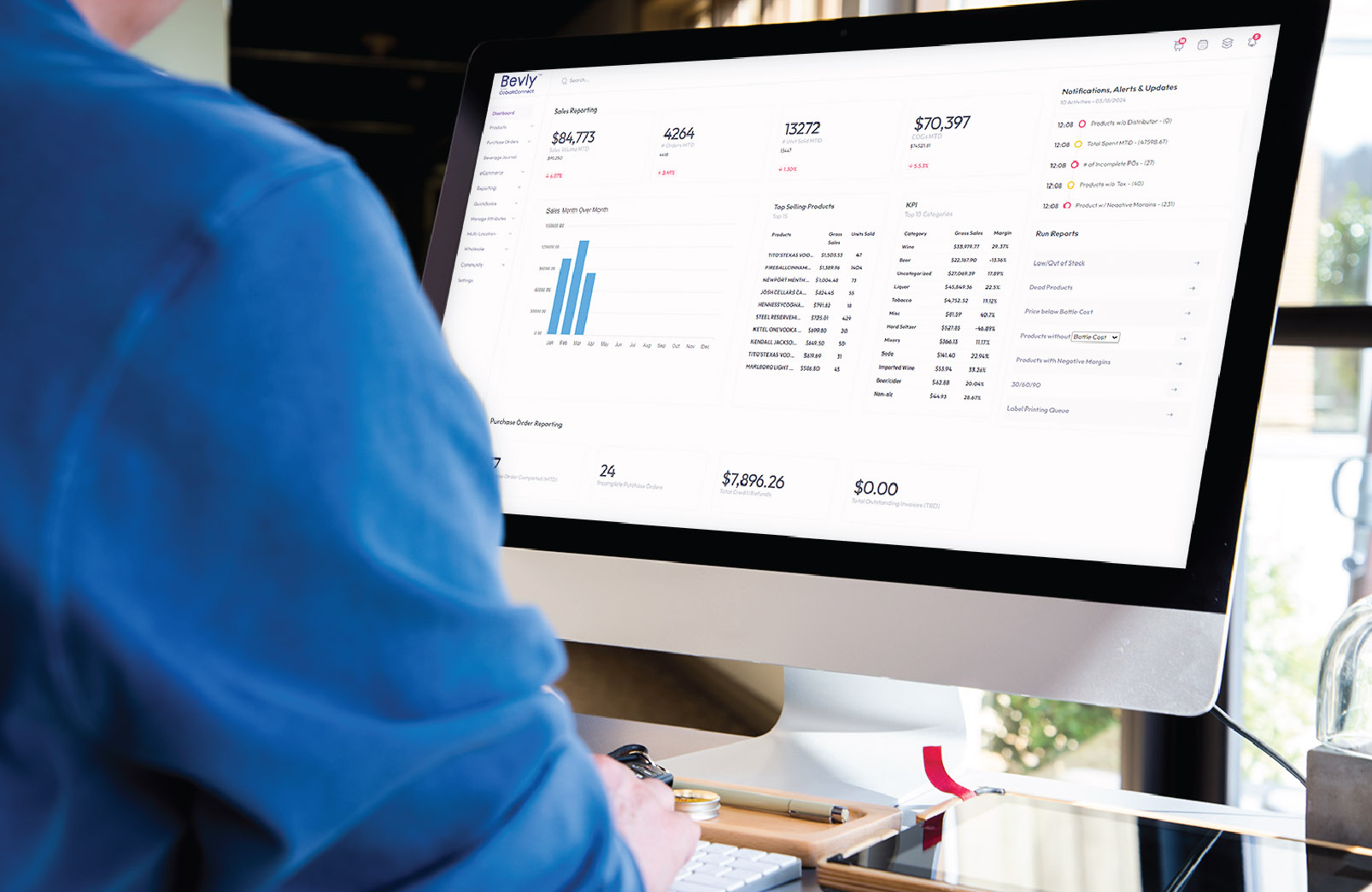
Bevly’s Dead Products Report helps retailers identify products that haven’t sold, understand what they paid for those products, and determine their current retail price.
Once you know what isn’t moving, you can decide whether to discount it, promote it, reposition it, or discontinue it.
5. You Find Out About Margin Problems After They’ve Already Cost You Money
Distributor costs change.
If the wholesale cost of a bottle increases but your retail price doesn’t, your margin shrinks.
That might not seem significant on one bottle. Multiply the problem across hundreds or thousands of SKUs and months of sales, however, and unnoticed cost increases can become expensive.
Your POS shouldn’t simply record your margins. It should help you protect them.
Bevly’s Profit Margin Alerts can help retailers identify margin issues so they can review pricing rather than discovering the problem months later.
6. You Have to Be at the Store to Know What’s Happening
Owning a liquor store shouldn’t mean being physically attached to it.
Store owners increasingly expect to be able to access important information remotely.
If you have to drive to the store or call an employee every time you want to check sales or inventory information, your POS may be limiting you.
Bevly provides Remote Access, giving owners greater visibility into their business when they aren’t standing behind the counter.
This becomes even more important for owners operating multiple locations.
7. Too Many Processes Depend on One Employee
Every liquor store has employees who know how to “make the system work.”
That can become a problem.
If only one manager knows how to receive invoices correctly, fix inventory problems, run reports, or update products, your operation becomes dependent on that employee’s knowledge.
When technology requires complicated workarounds and tribal knowledge, training new employees becomes harder and mistakes become more common.
A modern liquor store POS should simplify processes so employees can learn the system quickly and perform routine tasks consistently.
Good technology reduces dependence on individual employees by creating repeatable processes.
8. Your POS Gives You Data, but Not Answers
There is a major difference between having reports and having useful information.
Older POS systems can generate pages of data. The problem is figuring out what you are supposed to do with it.
Store owners need answers to practical questions:
- Which products aren’t selling?
- Which products have the best margins?
- Where are my margins declining?
- What inventory needs attention?
- Where are my inventory discrepancies?
- What should I stop buying?
A modern POS should help turn transaction data into information that helps you make better decisions.
Your system shouldn’t require you to become a data analyst just to understand your store.
9. Your POS Company Controls Who Processes Your Payments
This is an increasingly important consideration when evaluating a POS system.
Some POS companies require retailers to use a specific payment processor. That can limit your flexibility if pricing, service, technology, or your business needs change later.
Bevly is processor agnostic.
You can use Bevly with a compatible payment processor that works for your business, or use Bevly’s payment processing options if you choose.
If you later decide to change processors, you don’t have to abandon your Bevly profile simply because you want a different processing relationship.
Your store’s operational technology and data shouldn’t unnecessarily lock you into one payment-processing relationship.
10. You’re Spending More Time Managing Your POS Than Your POS Saves You
This may be the biggest warning sign of all.
Technology is supposed to eliminate work.
If your employees are constantly:
- Manually entering invoices
- Correcting inventory
- Updating costs
- Checking margins
- Building spreadsheets
- Re-entering information
- Searching through reports
- Performing manual inventory counts
- Fixing mistakes caused by duplicate data entry
Then your POS isn’t really saving you time.
It is simply digitizing manual work.
Modern liquor store technology should automate repetitive tasks and bring exceptions to your attention, allowing you to spend more time running the business.
A POS Should Help You Run the Store — Not Just Ring Up Customers
There was a time when a POS system’s primary responsibility was processing transactions.
That isn’t enough anymore.
Liquor stores manage thousands of SKUs, constantly changing wholesale costs, distributor relationships, inventory discrepancies, employee turnover, seasonal demand, margin pressure, and increasingly complex back-office operations.
Your POS sits at the center of all of it.
That’s why the question isn’t simply:
“Does my POS still work?”
The better question is:
“How much work is my current POS creating that modern technology could eliminate?”
If several of the signs above sound familiar, it may be time to evaluate whether your liquor store has outgrown its current POS system.
See What a Modern Liquor Store Platform Can Do
Bevly was designed specifically around the operational needs of beverage alcohol retailers.
With features including Automated Invoicing, Automated Receiving, Automated Payments, Dead Products Reporting, mobile Inventory Audits, Remote Access, Profit Margin Alerts, and processor flexibility, Bevly helps store owners spend less time performing repetitive administrative work and more time improving their businesses.
If your current POS is creating more work than it eliminates, see what changing your technology could do for your store.
See how much of your liquor store’s day-to-day work could be automated with Bevly.
“`