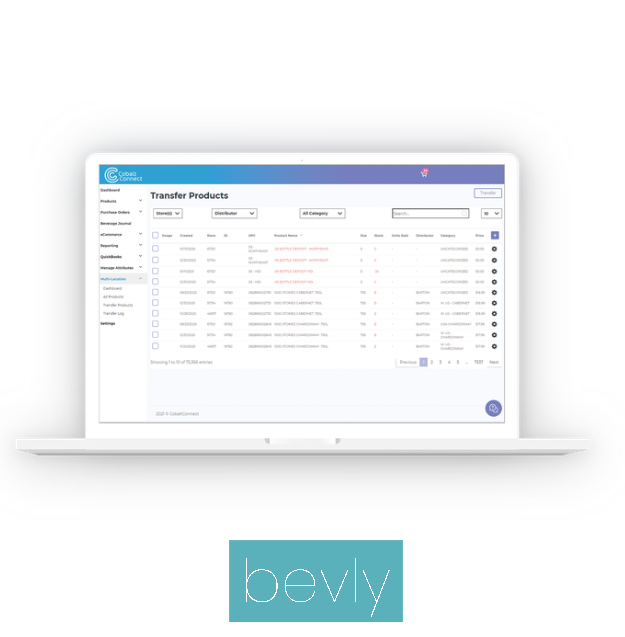
Liquor Store Inventory Management: A Complete Guide
Running a profitable liquor store requires much more than knowing what is sitting on the shelf. Liquor Store Inventory Management requires being informed about every product ont he shelf, products available to you, your customers, and their preferences
Every day, store owners and managers have to answer dozens of inventory questions:
- What needs to be reordered?
- Which products are selling fastest?
- Which bottles are sitting too long?
- Did the distributor invoice match what was delivered?
- Are costs updated correctly?
- Are margins where they should be?
- Is inventory accurate across every location?
For many liquor stores, answering those questions still requires spreadsheets, handwritten counts, manual purchase orders, invoice entry, and hours of back-office work.
That isn’t just inconvenient. Poor inventory management can quietly become one of the biggest drains on a liquor store’s profitability.
Bevly was built to change that.
Instead of treating inventory as a separate feature attached to a generic point-of-sale system, Bevly connects inventory, purchasing, distributor information, invoices, sales data, reporting, and store operations into a system designed specifically around the way liquor retailers operate.
For stores still spending hours every week counting products, updating costs, entering invoices, creating orders, and fixing inventory discrepancies, moving to a more automated system can potentially save 60–90 hours of manual work per month in higher-workload environments while helping uncover opportunities to improve profitability by 10% or more, depending on the store’s current processes, margins, purchasing habits, and inventory accuracy.
Want to see what that could look like in your store? Schedule a free Bevly consultation and demo here.
What Is Liquor Store Inventory Management?
Liquor store inventory management is the process of tracking, purchasing, receiving, pricing, selling, auditing, and replenishing every product in your store.
That sounds straightforward until you consider how complicated a liquor store’s catalog can become.
A retailer may carry thousands—or tens of thousands—of individual SKUs across beer, wine, spirits, mixers, ready-to-drink beverages, and other products. Those products may come from dozens of distributors with different case sizes, costs, UPCs, item numbers, invoices, promotions, and delivery schedules.
A good inventory management system therefore needs to do much more than tell you that you have six bottles of bourbon left.
It should help you understand:
- What you have in stock
- What you’re running low on
- What is selling
- What isn’t selling
- What should be reordered
- How much should be reordered
- What you paid for each product
- Which distributor carries each product
- Whether a delivery matches your purchase order
- Whether your margins are correct
- When products or costs have changed
- Which products deserve more—or less—of your cash
Most importantly, it should give you those answers without requiring your staff to spend countless hours manually assembling the information.
Why Traditional POS Inventory Systems Fall Short for Liquor Stores
Most modern POS systems offer some form of inventory tracking.
But there is an important difference between having an inventory feature and having an inventory system built around liquor retail.
A general retail POS might know that you sold a bottle.
It may not understand everything that happens before that bottle reaches the register.
Liquor retailers have to work with distributor catalogs, cases and individual bottles, purchase orders, frequently changing costs, invoices, credits, deliveries, minimum pricing requirements in certain markets, thousands of UPCs, and purchasing decisions across multiple vendors.
That’s where Bevly takes a different approach.
Rather than asking a liquor store to adapt its workflow to a generic POS system, Bevly is designed around the beverage alcohol supply chain itself.
Bevly connects your POS, distributors, purchase orders, invoices, payments, inventory, and reporting so information can flow through the business instead of constantly being re-entered by employees.
See how Bevly could work with your liquor store.
1. Real-Time Inventory Tracking
Accurate inventory starts with knowing what is actually in the store.
When inventory is managed manually, small mistakes compound quickly.
A product gets received but isn’t entered.
A case is entered as bottles.
A barcode is attached to the wrong product.
A cost doesn’t get updated.
An employee forgets to adjust an item.
Suddenly, the number on the computer and the number on the shelf are two completely different things.
Bevly helps create a much cleaner inventory process by keeping inventory information connected to purchasing, receiving, and sales.
Instead of relying on employees to repeatedly update the same information in multiple places, inventory movements can flow through the system and update stock levels as products move through the business.
That gives owners and managers a much more useful view of what is actually happening inside the store.
Better inventory accuracy means better decisions.
And better decisions mean less money trapped in the wrong products.
2. Scan-to-Track Inventory Audits
Physical inventory counts are one of the biggest time sinks in liquor retail.
Traditional audits can involve employees walking the store with clipboards, printed reports, spreadsheets, or handheld notes before somebody has to reconcile everything later.
Bevly’s inventory tools help simplify that process with scan-to-track auditing.
Employees can scan bottles, cases, and kegs as they move through the store, making it easier to record inventory without creating another manual administrative process.
The goal isn’t simply to make counting faster.
It’s to make inventory auditing something your team can do consistently enough that your data remains useful.
When owners trust their inventory numbers, they can make purchasing decisions with confidence instead of guessing.
3. Automated Purchase Orders
Ask many liquor store owners what they hate doing and purchase orders will be somewhere near the top of the list.
A typical manual ordering process can involve checking shelves, reviewing inventory, looking through distributor information, remembering what sold last week, entering quantities, checking costs, and then recreating much of the same information in a purchase order.
Bevly can automate much of that work.
Purchase orders can be built using information such as:
- Par levels
- Current inventory
- Low-stock alerts
- Sales velocity
- Distributor information
- Product costs
Instead of an employee manually deciding what needs to be ordered line by line, Bevly can help identify what needs attention and build more accurate purchase orders from real operating data.
That means purchasing becomes less about “I think we need another case” and more about “the data shows we need another case.”
Smarter ordering helps reduce two expensive problems at the same time:
Stockouts, which cost you sales.
And overstock, which ties up cash in products that may sit on the shelf for months.
If your managers spend hours every week building and checking orders, schedule a Bevly demo and see how much of that process can be automated.
4. Direct Distributor Integration
This is one of the biggest differences between Bevly and a traditional retail POS.
Your inventory doesn’t begin at the register.
It begins with your suppliers.
Bevly’s distributor network is designed to bring distributor information directly into the system, including invoices, pricing, and product information from supported distributors.
That creates opportunities to automate work that liquor stores traditionally perform manually.
Instead of repeatedly entering vendor information, UPCs, pack sizes, product costs, and invoice details, Bevly can match distributor information against your catalog.
That means cleaner data and significantly less duplicate work.
Bevly’s distributor tools can support:
- Direct invoice syncing
- Distributor product data
- Pricing information
- Case, bottle, UPC, and pack-size matching
- Purchase-order creation
- Delivery reconciliation
- Distributor payment workflows
For liquor retailers, this is a major distinction.
A generic POS tends to focus on what happens when the customer purchases the bottle.
Bevly is designed to help manage what happens from the distributor all the way through the sale.
5. Digital Invoices and Receiving
Receiving a delivery shouldn’t create another hour of paperwork.
But in many stores, that’s exactly what happens.
Products arrive.
Someone checks the shipment.
Someone finds the invoice.
Someone enters or updates products.
Someone adjusts costs.
Someone updates quantities.
And if anything doesn’t match, someone has to figure out why.
Bevly helps digitize and connect that workflow.
Distributor invoices can flow into Bevly, where products can be matched against the store’s inventory catalog. Receiving the order can then update inventory information instead of requiring employees to re-enter everything manually.
That can dramatically reduce administrative work while also reducing costly mistakes.
A wrong quantity, incorrect cost, mismatched product, or missed credit may seem small.
Across thousands of products and hundreds of deliveries, those small errors add up.
6. Low-Stock Alerts and Smarter Reordering
Running out of your best-selling bottle on Friday afternoon isn’t just an inventory mistake.
It’s lost revenue.
At the same time, ordering six cases of something that sells twice a month isn’t good inventory management either.
The objective is to have the right product, in the right quantity, at the right time.
Bevly can monitor inventory and help identify products approaching their reorder points.
Combined with sales velocity and par levels, that allows stores to create a more disciplined replenishment process.
Your team doesn’t have to remember every SKU.
The system helps identify what needs attention.
That is particularly valuable in stores managing thousands of products where visual shelf checks alone simply aren’t enough.
7. Better Purchasing Decisions From Sales Data
One of the most expensive phrases in liquor retail is:
“I think it sells pretty well.”
Purchasing decisions shouldn’t be based solely on memory.
Bevly combines inventory information with sales insights so owners can understand what is actually moving.
That can help answer questions such as:
- Which products consistently sell?
- Which products are slowing down?
- Which items should be reordered more frequently?
- Which products are tying up cash?
- Which categories perform best during certain periods?
- What products should receive more shelf space?
- Which products may need a promotion?
Over time, those decisions can materially affect profitability.
If a store can move more capital into faster-selling, healthier-margin products while reducing slow-moving inventory, the same shelf space and inventory budget can generate more return.
8. Inventory and Margin Accuracy
Inventory accuracy and profitability are closely connected.
If your product cost is wrong, your margin reporting is wrong.
If your quantities are wrong, your purchasing recommendations may be wrong.
If your invoice data isn’t current, you may be making pricing decisions using outdated information.
Bevly helps reduce those problems by connecting distributor costs, invoices, purchasing, receiving, inventory, and sales information.
That gives owners a clearer understanding of what they’re actually making on the products they sell.
And sometimes the biggest profitability opportunities aren’t about selling more.
They’re about discovering where you’re already losing money.
A store may uncover:
- Products priced below intended margin
- Incorrect product costs
- Inventory discrepancies
- Duplicate or mismatched products
- Excess slow-moving inventory
- Missed distributor credits
- Products that need repricing
- Purchasing patterns that unnecessarily tie up cash
Fixing enough small leaks can make a surprisingly large difference to annual profit.
9. Multi-Location Inventory Management
Operating one liquor store is complicated.
Operating several stores can multiply the problem.
Without centralized product data, owners may find themselves adding the same product at multiple locations, maintaining separate catalogs, comparing separate reports, and trying to determine where inventory should be allocated.
Bevly’s multi-location tools are designed to centralize that information.
Owners can gain greater visibility across stores while creating more consistent product and inventory processes.
That makes it easier to understand what is selling at each location and where inventory may need to move.
For growing liquor retailers, that scalability matters.
The system that worked when you operated one store shouldn’t become the thing holding you back when you open store number two, three, or ten.
Talk to Bevly about managing inventory across your locations.
10. Peak Sales and Store Analytics
Inventory doesn’t exist in isolation.
When products sell matters too.
Bevly’s reporting tools can help retailers analyze sales activity by time of day, identify peak periods, plan staffing, understand sales trends, and make more informed inventory decisions.
That information can influence more than purchasing.
It can help stores:
- Staff more efficiently
- Plan promotions during slower periods
- Prepare inventory for high-demand periods
- Understand changing customer behavior
- Forecast demand
- Reduce unnecessary labor
When your POS and inventory systems produce useful operational data, the software stops being a cash register and starts becoming a management tool.
Where Do the 60–90 Hours of Potential Monthly Savings Come From?
The biggest cost of manual inventory management isn’t always visible on a financial statement.
It’s time.
Consider all the repetitive tasks that happen throughout a month:
- Manual inventory counts
- Purchase-order creation
- Invoice entry
- Receiving
- Updating product costs
- Matching products and UPCs
- Entering distributor information
- Checking low-stock products
- Reconciling deliveries
- Correcting inventory discrepancies
- Updating products
- Running reports
- Checking margins
- Reviewing reorder quantities
Even saving two or three hours per working day can quickly represent 60 or more hours per month.
For stores with larger catalogs, multiple locations, heavier receiving volume, or especially manual processes, those savings can climb higher.
Bevly’s internal analysis has identified stores losing more than 60 hours per month to manual processes, while Bevly’s broader savings model estimates hundreds of hours can be recovered annually through automation.
The value isn’t simply that employees work fewer hours.
It’s that owners, managers, and employees can spend those hours on things that actually grow the business.
- Serving customers
- Improving merchandising
- Training staff
- Finding new products
- Negotiating with suppliers
- Building eCommerce
- Marketing the store
- Opening another location
Or, in many cases, simply giving the owner some of their life back.
How Better Inventory Management Can Improve Profitability by 10% or More
Saving labor is only one part of the equation.
The larger opportunity comes from improving how the store uses its money.
Inventory is capital sitting on your shelves.
If too much of that capital is invested in products that don’t sell, it can’t be used somewhere else.
If popular products are constantly out of stock, you’re losing sales.
If costs aren’t updated correctly, you’re losing margin.
If pricing mistakes go unnoticed, you’re losing profit.
If employees spend dozens of hours performing work software could automate, you’re paying for unnecessary labor.
If purchasing decisions are based on guesswork, you’re exposing the business to all of these problems simultaneously.
Bevly attacks those issues from multiple directions:
- Reduce labor costs
- Reduce inventory errors
- Improve product-cost accuracy
- Reduce stockouts
- Reduce over-ordering
- Improve purchasing decisions
- Identify sales trends
- Improve margin visibility
- Reduce slow-moving inventory
- Free managers to focus on revenue-producing work
For stores starting with significant manual inefficiencies, the combined impact can create a path toward 10%+ improvements in profitability over time. Actual results will depend on a store’s starting point, sales volume, labor structure, inventory accuracy, margins, and how consistently the tools are used.
And unlike simply trying to increase revenue, many of these improvements attack costs and margin leakage directly—which means more of the benefit can reach the bottom line.
Find out where Bevly could help your store save time and improve margins.
Bevly vs. a Generic POS: What’s the Difference?
The easiest way to understand Bevly is to stop thinking of it as simply another cash register.
A traditional retail POS is primarily designed to answer:
What did I sell?
A modern liquor-store management platform needs to help answer:
- What did I sell?
- What do I have?
- What should I buy?
- Who should I buy it from?
- What did it cost?
- Did the delivery match the invoice?
- Is my margin correct?
- When will I need it again?
- What is wasting my money?
- Where should I invest my inventory dollars next?
Bevly combines Clover’s POS infrastructure with liquor-specific tools including advanced inventory management, distributor connectivity, automated purchase orders, invoice workflows, detailed reporting, advanced returns and inventory updates, multi-location management, automated discounts, and other workflows built specifically for liquor retailers.
That’s the difference between software that records transactions and software that helps you operate the business.
Your Inventory System Should Make Running Your Store Easier
Liquor store owners already have enough to manage.
Inventory software shouldn’t create another job.
It should eliminate jobs that shouldn’t have been manual in the first place.
The goal of better inventory management isn’t to generate prettier reports.
It’s to give you more accurate inventory, smarter purchasing, fewer mistakes, less wasted labor, healthier margins, and more time to grow your business.
If you’re spending nights creating orders, fixing inventory, updating spreadsheets, entering invoices, or wondering whether your numbers are accurate, there’s a better way to run the store.
Bevly was built specifically around the workflows liquor retailers deal with every day—from the distributor to the shelf to the register.
Find Out How Much Time and Money Your Store Could Save
Every liquor store operates differently, which is why Bevly can walk through your current processes and show you where automation could save time, reduce errors, and improve profitability.
Schedule your free Bevly demo today.
See how automated ordering, distributor integrations, inventory management, reporting, and liquor-specific POS tools can change the way you operate.
Click here to contact Bevly and schedule your free consultation.